

In today's era of pursuing efficiency and quality, the catering and food processing industries are also increasingly pursuing high efficiency. As an important kitchen equipment, commercial vegetable cutters play an increasingly important role in this industry. The emergence of vegetable cutters has changed the traditional manual vegetable cutting mode, and has brought many conveniences and advantages to the industry in a more relaxed and convenient way. More and more restaurants and food processing industries need to process vegetables and fruits, which provides a perfect solution for the emergence of commercial vegetable cutters. It has brought many conveniences and advantages to people and the food industry.
The purpose of this article is to introduce you to some knowledge about commercial vegetable cutters. If you are looking for or intend to buy a vegetable cutter, then this article is an article you must learn, which can help you get useful knowledge and make the right choice before choosing to buy.
Types and working principles of commercial vegetable cutters
Commercial vegetable cutters are used in many rich and diverse types. According to different cutting principles, they can be divided into rotary, reciprocating, etc., and according to the cutting method, there are slicing, shredding, and dicing. In addition, from the perspective of automation, they include fully automatic and semi-automatic. These different types of vegetable cutters have similar basic structures.
(1) Rotary vegetable cutter
The rotary vegetable cutter mainly relies on the high-speed rotation of the cutter to cut vegetables. The cutter is installed on a rotating shaft. When the machine is started, the rotating shaft drives the cutter to rotate at an extremely high speed. When the vegetables are transported to the bottom or near the cutter in an orderly manner through the feed port, they are cut into vegetable slices, vegetable cubes, etc. under the rotation and cutting of the cutter. The desired cutting method can be customized for you. For example, when we need to cut potatoes into potato slices, the potatoes will approach the rotating blade at a uniform speed under the push of the feed device. The rotation speed of the blade and the feed speed are precisely matched to ensure that the thickness of the cut potato slices is uniform, which can ensure that it is more accurate and consistent than manual cutting.
(2) Reciprocating vegetable cutter
The cutter of the reciprocating vegetable cutter reciprocates. The cutter moves back and forth on a specific track, like a saw. When the vegetables enter from the feed port, they will be cut at the appropriate position by the reciprocating cutter. This cutting method is very effective for some vegetables with a harder texture or that need to be cut to a precise length. For example, parsley, garlic sprouts, leeks, etc. need to be cut.
Basic components of a vegetable cutter
The composition of a commercial vegetable cutter is very simple
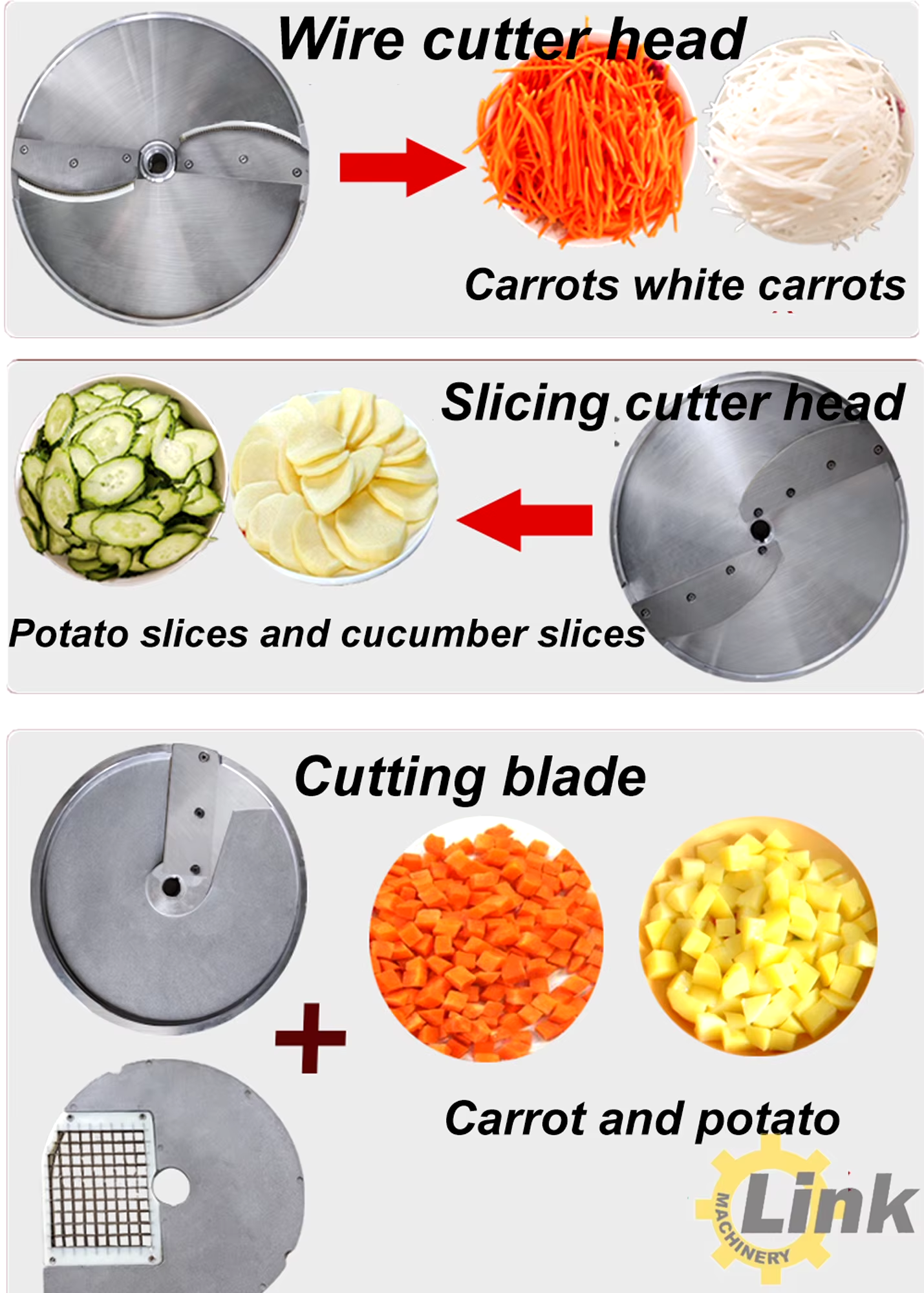
(1) Different shapes of knives
Different types of vegetable cutters have different knife options. Sharp disc-shaped knives are often used for slicing in rotary vegetable cutters, while serrated knives may be more suitable for shredding.
(2) Discharge port
This part is to ensure that the cut vegetables can be output neatly and collect and discharge the vegetables or fruits cut by the knife.
(3) Transmission device
The key to ensuring the stable operation of the machine is to transmit power to the knife so that it can work efficiently, which is equivalent to the commander in charge of the overall situation.
(4) Shell
The shell protects the internal structure and the operator's safety to avoid accidental injuries.
Factors to consider when choosing a commercial vegetable cutter
1. Clarify the need for cutting materials
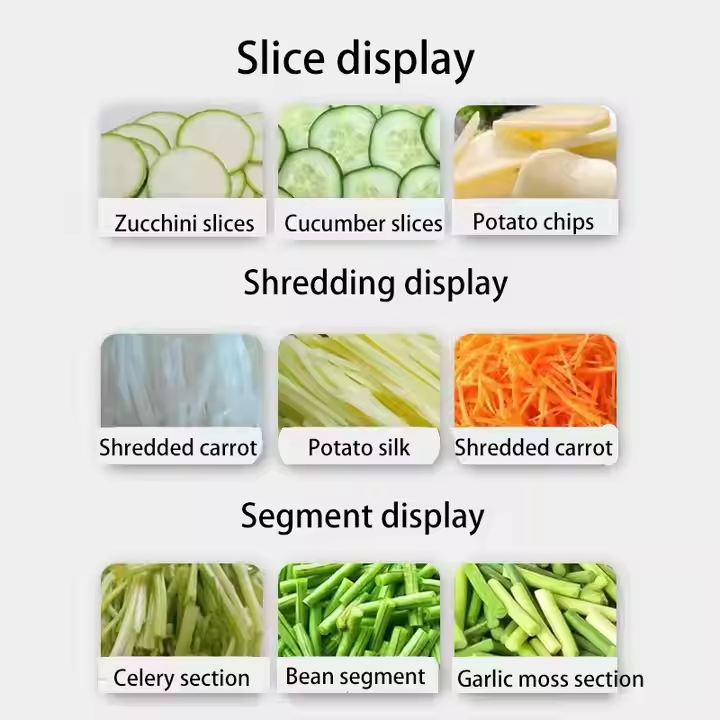
When choosing a commercial vegetable cutter, the company must first determine the cutting needs based on its own business type and dish production requirements. If it is a restaurant, it may mainly need slicing function to process various meats and vegetables; while a dumpling restaurant needs shredding and mincing functions to prepare the ingredients for dumpling fillings. At the same time, you should also consider the amount of cutting and choose a machine with appropriate cutting capacity according to the expected business volume.
2. Clarify your budget
The price of commercial vegetable cutters is often divided into different prices due to factors such as brand, function, and quality, so the price range is relatively wide. Low-end products may have relatively simple functions and more affordable prices; but mid-range products have certain improvements in performance and quality; high-end products often have more advanced functions and better durability. This requires you to choose the most cost-effective and durable machine within your budget according to your own economic strength and usage needs.
3. Pay attention to after-sales service and brand
Well-known brands often provide high-quality after-sales service, so that you can also have high-quality service after purchase to complete the use of the vegetable cutter.
4. Consider the use space and installation conditions
The size of the space in the kitchen or food processing site is an important factor to consider when choosing a commercial vegetable cutter. You need to choose a machine of the right size to ensure that it can be placed reasonably and can be used and operated in a safe manner. At the same time, you must also consider the installation conditions, such as power requirements and ventilation requirements, to ensure that the machine can be installed and operated normally.
As an important equipment in the modern catering and food processing industries, commercial vegetable cutters have brought significant benefits to enterprises with their advantages of high efficiency, high quality, safety and hygiene. Therefore, when choosing a commercial vegetable cutter, full understanding and preparation can help you choose the right machine.

Email : Molly@xmlk-machine.com
EMAIL us
Room 820, No. 289-7, wengjiao Road, xiamen, Fujian, China
Our Address
Tel : +86 18150150881
Whatsapp : +8618150150881
call us


 English
 français
 português
 ไทย
ไทย